I'm reading books on management. Multipliers by Liz Wiseman and Greg McKeown is clear and inspiring. Everyone needs to read it! I'm providing a summary here to highlight the main points, focusing on the positive behaviors that should be developed.
Some bosses are Multipliers. They are able to unlock intelligence and output from their people, and do more with what they have. When you work with a Multiplier, you give more of yourself you ever thought was possible. You grow your capabilities and value.
Some bosses are Diminishers. They shut down the intelligence and output of their people, even though they are highly intelligent themselves. When you work for a Diminisher, you lose motivation, do not accomplish as much, and may even decrease in value.
Most people are in between. You can turn yourself into a Multiplier, by neutralizing your weaknesses and enhancing your strengths in 5 key areas:
1) Talent Magnet vs Empire Builder
a- Look for talent everywhere: Observe. How is this person smart? Appreciate all types of genius.
b- Find people's native genius: What can he/she do exceptionally well, and absolutely naturally? Why? Discover the basic capability that leads to this exceptional performance. Label it. Confirm the hypothesis with their colleagues and themselves.
c- Utilize people at their fullest: Connect them with stretch opportunities to develop their native genius. Where else can this person's aptitude benefit the company? Test them in ad-hoc roles.
d- Remove the blockers: Get rid of Prima Donnas who overrun others and impede their growth. Sometimes the blocker is yourself.
--> Talent Magnets develop their people and move them to bigger and better opportunities. This draws even more talent into their organization.
2) Liberator vs Tyrant
a- Create space: Reserve your opinions, create space for others to talk. Distinguish between hard and soft opinions. Operate consistently. (eg. Always demand that opinions are backed by data.) Level the playing field. (eg. Hire translators for international teams.)
b- Demand best work: Defend the standard. Distinguish best work from bad outcomes.
c- Generate rapid learning cycles: Admit and share mistakes. Allow them to fail, then insist on learning from mistakes.
--> Liberators create an environment where people are free to contribute their work and opinions, without fear of blame if experiments do not work out. However, they demand that everyone do their best work, back up opinions with data, and learn from their mistakes.
3) Challenger vs Know-It-All
a- Seed the Opportunity: Show the need. Frame problems into opportunities. Challenge the assumptions. Create a starting point for the team to fully define the opportunity.
b- Lay down a Challenge: Extend a concrete challenge. Ask the hard questions. Ask more, tell less. Let them discover the answers.
c- Generate belief in what is possible: Helicopter down. Lay out a path, co-create the plan. Connect to the specific steps needed to create movement. Orchestrate an early win.
--> Challengers stretch people by extending challenges and letting them find the answers. Their role is not to solve problems (even if they have a solution), but to ask guiding questions, challenge assumptions, and ensure development of a concrete plan of action. An 'impossible' challenge can create more safety than asking for something easier.
4) Debate Maker vs Decision Maker
a- Frame the Issue: Define the question, form the team, assemble the data, frame the decision. Ask the hard question.
b- Spark the debate: Create safety for best thinking. Demand rigor. Ask for the data. Make everyone contribute.
c- Drive a sound decision: Clarify the decision making process. Make the decision. Communicate the decision and rationale.
--> Rigorous debate leads to sound decisions and strong teams. People understand the underlying rationale and can execute more effectively. The Debate Maker asks the key questions at the root of the issue, allows others to find the answers, and drives a transparent and sound decision based on data.
5) Investor vs Micro-Manager
a- Define ownership: Name the lead, give him 51% of the vote and 100% of the responsibility. Give ownership of the big picture, not just for the specific job function.
b- Invest resources: Teach and coach instead of jumping in with the answers. "What do we know about what doesn't work? What assumptions led us to these outcomes? What risks do we face now that need to be mitigated? What solutions do you see to this problem?" Provide backup (another team member, not yourself).
c- Hold people accountable: Don't assume responsibility for fixing the problem. Get involved, but stretch them with questions instead of providing answers. Allow failure, then help them learn. Find the metrics that matter (number of passes, shots on goal) and make the scorecard visible -- people will see where they need to improve.
--> Investors are coaches, not players. How would you coach if you're not allowed to enter the playing field? The role of the investor is not to solve problems, but to grow a team that can solve problems.
Fast track to become a Multiplier:
- Know thyself. What are your strengths and weaknesses?
- Neutralize your biggest weakness, and enhance your strongest strength.
- Assume that people are smart and can figure things out. Make decisions based on that assumption.
- Pick one practice in one of the five disciplines, and work on it for 30 days.
There are more details in the book, but these are the main points. Get Multipliers from Amazon for more strategies and case studies.
Wednesday, December 9, 2015

Friday, September 11, 2015
Getting More by Stuart Diamond - A Summary
This is a summary of Getting More by Prof. Stuart Diamond. I wanted to remember the strategies from the book, so I've posted a book review / book report here for easy reference. You can also check out the companion website.
Getting More presents strategies on how to prepare for and conduct negotiations. Negotiations range from asking for a discount on a purchase, to getting a job, to establishing peace in your family, work, and the Middle East. (i.e. EVERYTHING is a negotiation!)
My key takeaway is that successful negotiation requires you to remove your ego, in order to focus on your goals and the other person's needs.
The 30,000ft summary is to ask ourselves 3 questions:
A. What are my goals?
B. Who are they?
C. What will it take to persuade them?
The book jumps around different strategies, so it's not easy to remember all the good stuff. My goal here is to pull out key learnings from the book, so I can give myself (and you!) a quick refresher on How to Get More.
Preparing for the Negotiation
A. What are my goals?
1. Goals: Short/long term
- Dig deeper, get to the root of your need. "Earn more money" may not be the end goal, which may instead be "Buy a house", or "Spend time with family".
- Understand everyone's goals. Even people in the same team may have different goals. At meetings, ask "What do you want at the end of this meeting that you don't have now?"
B1. Who are they?
2. Parties: Decision marker, 3rd parties
- Who is the decision maker on the other side. Try to go straight to him/her. "Hello, do you have the power to do X?"
- Which 3rd parties can influence the decision maker? Are they are more accessible or persuadable?
B2. What is the picture in their heads?
(Strategy: Do a mock negotiation with role reversal-- argue from the perspective of the other party)
3. Problem(s): in reaching goals
- Find the real problem, and turn it into an opportunity. Ask WHY the other party is acting the way they are. A dispute over a child's curfew or a business valuation may really be a problem of trust, and an opportunity for a better relationship.
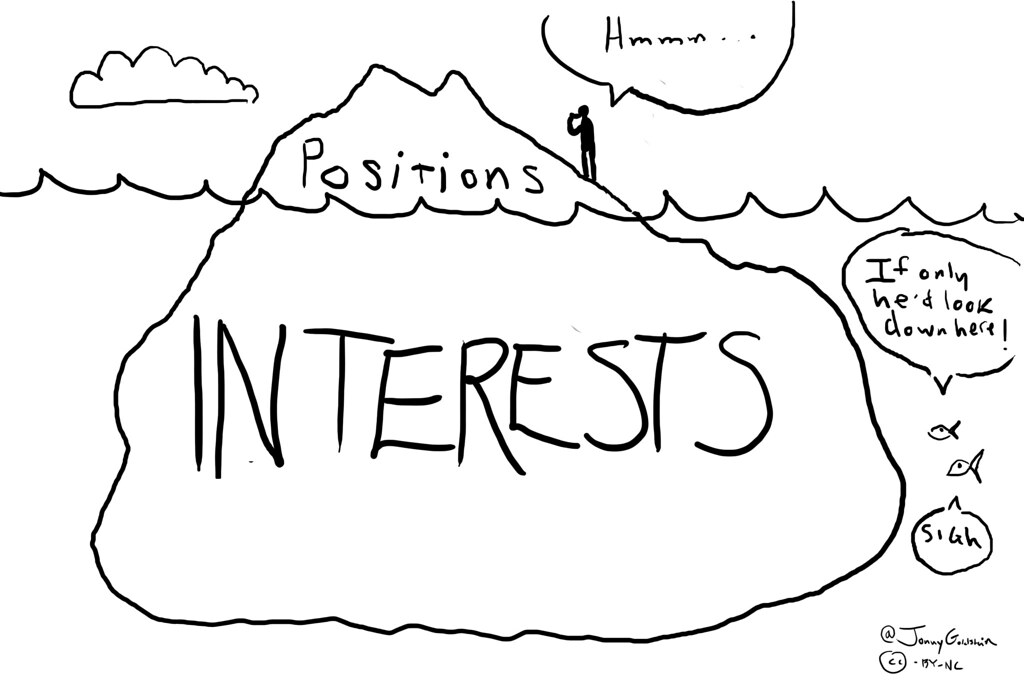
4. Needs/Interests: Rational, emotional, shared, conflicting, unequally valued.
- What are their needs/interests? What are their hopes and fears? How can you help them?
- Emotional Needs have to be met before a deal can be made. Make emotional payments with empathy, apologies, and by valuing the other party. eg. Thank the police officer for doing their job, keeping the roads safe etc. Acknowledge the other party's position and power. Be sincere. Think about what their emotional need is and tailor your action to meet it.
5. Perceptions: culture, conflicts, trust
- The right answer to "I hate you" is "Tell me more"
6. Communication: style, relationship?
- What is their preferred communication medium/style?
- How do they form relationships? Straight to business? Or small talk?
C. What will it take to persuade them?
7. Standards: Theirs, norms
- What are their published policies/ standards/ promises/ guarantees?
- What is the standard for the industry/ norms in society?
- Ask them to meet their standards: "Is it your policy to send shirts back to the customer with fewer buttons than they arrived with?" "Isn't high customer service part of your promise? How can you help me remain as a customer?" "Will you agree that no one should interrupt anyone else?" "Do you think it's fair for residents who make the least noise to receive attention last?" "I promise to try hard never to interrupt you. May I have the same consideration?"
- Ask for exceptions: "Has the company ever made an exception to this policy?"
- Ask them to set a standard. eg. Ask for the criteria used to decide raises and bonuses. Get as specific as possible, both about their needs and the amount of bonus.
8. Incremental: Steps to reduce risk.
- Lead the other side slowly with incremental thoughts, or incremental actions.
9. Brainstorm: Options to meet goals and needs. What to trade or link?
- Expand the pie. What items of unequal value can be traded? eg. Lower price for more referrals, holiday work for more vacation days.
- Give them the problem. Use empathy or just ask for help. "What is possible here?" "How can you help to create a solution here?"
10. 3rd parties: Common enemies, influencers
- Who/what is a common enemy we can invoke?
- Who do they respect?
- Who else do you need to account for who is not there? Their boss? Spouse? Colleagues? Can you ally with them to find arguments to persuade their unreasonable boss? Save face in front of their spouse?
11. Framing: Create a vision, develop questions
- Give them a vision of where you want them to go. "Is it your goal to make your customers happy?"
- Summarize what you think you're hearing. "So, you telling me that I should transfer my balance from your card with 17.9% APR to the other bank who is offering 11%?"
12. Who presents: How and to whom?
- Who on my team will be most likely to get the other party to meet my goals? Who is the right negotiator on the other side? The more powerful people are, the less attention they pay to the other side's needs. A more junior member of the team may be a better negotiator.
- Do we need a cross-cultural interface manager? ie. Someone who knows both cultures and is trusted by both.
- Accommodating people are good openers, they help connect with the other party.
- Aggressive, goal directed people are good closers, they will make sure the deal gets done.
- Collaborators make good facilitators, the consider the needs of all parties.
- Compromisers are good in an emergency, they can make decisions quickly.
13. Commitments/incentives for adherence: Especially for them.
- How do they make commitments? Do they honor contracts? Are they trustworthy? If not, take only incremental steps to reduce risk to yourself.
- Set incentives or penalties for adherence or non-adherence. "It will give me comfort and cost you nothing if what you say is true."
14. Next steps: Who does what?
---------------------------------------
During the Negotiation:
- Set an agenda. Start with the easy things to give both parties a sense of accomplishment.
- Do not get emotional or distracted from your goals. React to accusations by asking for information.
- Focus on the future, not on assigning blame for the past. Ask "What do we do now and how do we prevent this from happening again."
- Establish a relationship, focus on the other party. Listen and ask questions.
- Look for small signals. "I can't sell you these files." --> "Can someone else make this decision?" "Who can you sell them to - my university department instead of the student group?" "Can you give me these files?"
- Be persistent and incremental.
- Always communicate:
--- State the obvious. "We don't seem to be getting along. Why not?"
--- Acknowledge differences openly. Find out their fears and address them.
--- Apologize in advance. "I might accidentally say something inappropriate. I wish I knew your culture better. Every time I make a mistake, could you please advise me?"
--- Be collaborative, not confrontational. "Please tell me where I'm wrong here."
In general:
- Consult before deciding. "I need to make a decision on this by x time tomorrow. If I don't hear from you by then, I'll assume it's okay to proceed as outlined."
--------------------------------------
Whew. That was a lot. There's more in the book, and I found the case studies especially useful. Buy Getting More from Amazon if you want more material. There are specific scenarios for getting a job, negotiating with children, and more. Again, my key takeaway is that successful negotiation requires you to remove your ego, in order to focus on your goals and the other person's needs.
Was this useful for you? Please drop me a comment on how to improve!
Getting More presents strategies on how to prepare for and conduct negotiations. Negotiations range from asking for a discount on a purchase, to getting a job, to establishing peace in your family, work, and the Middle East. (i.e. EVERYTHING is a negotiation!)
My key takeaway is that successful negotiation requires you to remove your ego, in order to focus on your goals and the other person's needs.
The 30,000ft summary is to ask ourselves 3 questions:
A. What are my goals?
B. Who are they?
C. What will it take to persuade them?
The book jumps around different strategies, so it's not easy to remember all the good stuff. My goal here is to pull out key learnings from the book, so I can give myself (and you!) a quick refresher on How to Get More.
Preparing for the Negotiation
A. What are my goals?
1. Goals: Short/long term
- Dig deeper, get to the root of your need. "Earn more money" may not be the end goal, which may instead be "Buy a house", or "Spend time with family".
- Understand everyone's goals. Even people in the same team may have different goals. At meetings, ask "What do you want at the end of this meeting that you don't have now?"
B1. Who are they?
2. Parties: Decision marker, 3rd parties
- Who is the decision maker on the other side. Try to go straight to him/her. "Hello, do you have the power to do X?"
- Which 3rd parties can influence the decision maker? Are they are more accessible or persuadable?
B2. What is the picture in their heads?
(Strategy: Do a mock negotiation with role reversal-- argue from the perspective of the other party)
3. Problem(s): in reaching goals
- Find the real problem, and turn it into an opportunity. Ask WHY the other party is acting the way they are. A dispute over a child's curfew or a business valuation may really be a problem of trust, and an opportunity for a better relationship.
4. Needs/Interests: Rational, emotional, shared, conflicting, unequally valued.
- What are their needs/interests? What are their hopes and fears? How can you help them?
- Emotional Needs have to be met before a deal can be made. Make emotional payments with empathy, apologies, and by valuing the other party. eg. Thank the police officer for doing their job, keeping the roads safe etc. Acknowledge the other party's position and power. Be sincere. Think about what their emotional need is and tailor your action to meet it.
5. Perceptions: culture, conflicts, trust
- The right answer to "I hate you" is "Tell me more"
6. Communication: style, relationship?
- What is their preferred communication medium/style?
- How do they form relationships? Straight to business? Or small talk?
C. What will it take to persuade them?
7. Standards: Theirs, norms
- What are their published policies/ standards/ promises/ guarantees?
- What is the standard for the industry/ norms in society?
- Ask them to meet their standards: "Is it your policy to send shirts back to the customer with fewer buttons than they arrived with?" "Isn't high customer service part of your promise? How can you help me remain as a customer?" "Will you agree that no one should interrupt anyone else?" "Do you think it's fair for residents who make the least noise to receive attention last?" "I promise to try hard never to interrupt you. May I have the same consideration?"
- Ask for exceptions: "Has the company ever made an exception to this policy?"
- Ask them to set a standard. eg. Ask for the criteria used to decide raises and bonuses. Get as specific as possible, both about their needs and the amount of bonus.
8. Incremental: Steps to reduce risk.
- Lead the other side slowly with incremental thoughts, or incremental actions.
9. Brainstorm: Options to meet goals and needs. What to trade or link?
- Expand the pie. What items of unequal value can be traded? eg. Lower price for more referrals, holiday work for more vacation days.
- Give them the problem. Use empathy or just ask for help. "What is possible here?" "How can you help to create a solution here?"
10. 3rd parties: Common enemies, influencers
- Who/what is a common enemy we can invoke?
- Who do they respect?
- Who else do you need to account for who is not there? Their boss? Spouse? Colleagues? Can you ally with them to find arguments to persuade their unreasonable boss? Save face in front of their spouse?
11. Framing: Create a vision, develop questions
- Give them a vision of where you want them to go. "Is it your goal to make your customers happy?"
- Summarize what you think you're hearing. "So, you telling me that I should transfer my balance from your card with 17.9% APR to the other bank who is offering 11%?"
12. Who presents: How and to whom?
- Who on my team will be most likely to get the other party to meet my goals? Who is the right negotiator on the other side? The more powerful people are, the less attention they pay to the other side's needs. A more junior member of the team may be a better negotiator.
- Do we need a cross-cultural interface manager? ie. Someone who knows both cultures and is trusted by both.
- Accommodating people are good openers, they help connect with the other party.
- Aggressive, goal directed people are good closers, they will make sure the deal gets done.
- Collaborators make good facilitators, the consider the needs of all parties.
- Compromisers are good in an emergency, they can make decisions quickly.
13. Commitments/incentives for adherence: Especially for them.
- How do they make commitments? Do they honor contracts? Are they trustworthy? If not, take only incremental steps to reduce risk to yourself.
- Set incentives or penalties for adherence or non-adherence. "It will give me comfort and cost you nothing if what you say is true."
14. Next steps: Who does what?
---------------------------------------
During the Negotiation:
- Set an agenda. Start with the easy things to give both parties a sense of accomplishment.
- Do not get emotional or distracted from your goals. React to accusations by asking for information.
- Focus on the future, not on assigning blame for the past. Ask "What do we do now and how do we prevent this from happening again."
- Establish a relationship, focus on the other party. Listen and ask questions.
- Look for small signals. "I can't sell you these files." --> "Can someone else make this decision?" "Who can you sell them to - my university department instead of the student group?" "Can you give me these files?"
- Be persistent and incremental.
- Always communicate:
--- State the obvious. "We don't seem to be getting along. Why not?"
--- Acknowledge differences openly. Find out their fears and address them.
--- Apologize in advance. "I might accidentally say something inappropriate. I wish I knew your culture better. Every time I make a mistake, could you please advise me?"
--- Be collaborative, not confrontational. "Please tell me where I'm wrong here."
In general:
- Consult before deciding. "I need to make a decision on this by x time tomorrow. If I don't hear from you by then, I'll assume it's okay to proceed as outlined."
--------------------------------------
Whew. That was a lot. There's more in the book, and I found the case studies especially useful. Buy Getting More from Amazon if you want more material. There are specific scenarios for getting a job, negotiating with children, and more. Again, my key takeaway is that successful negotiation requires you to remove your ego, in order to focus on your goals and the other person's needs.
Was this useful for you? Please drop me a comment on how to improve!
Subscribe to:
Comments (Atom)